The Guardians of the Olive Trees: When Trees Speak with the Tongue of Ancestors
"Every year, between late October and early December, the Palestinian mountains rise to announce the start of the olive harvest—a journey where the farmer’s toil blends with the blessing of the 'Green Gold'."
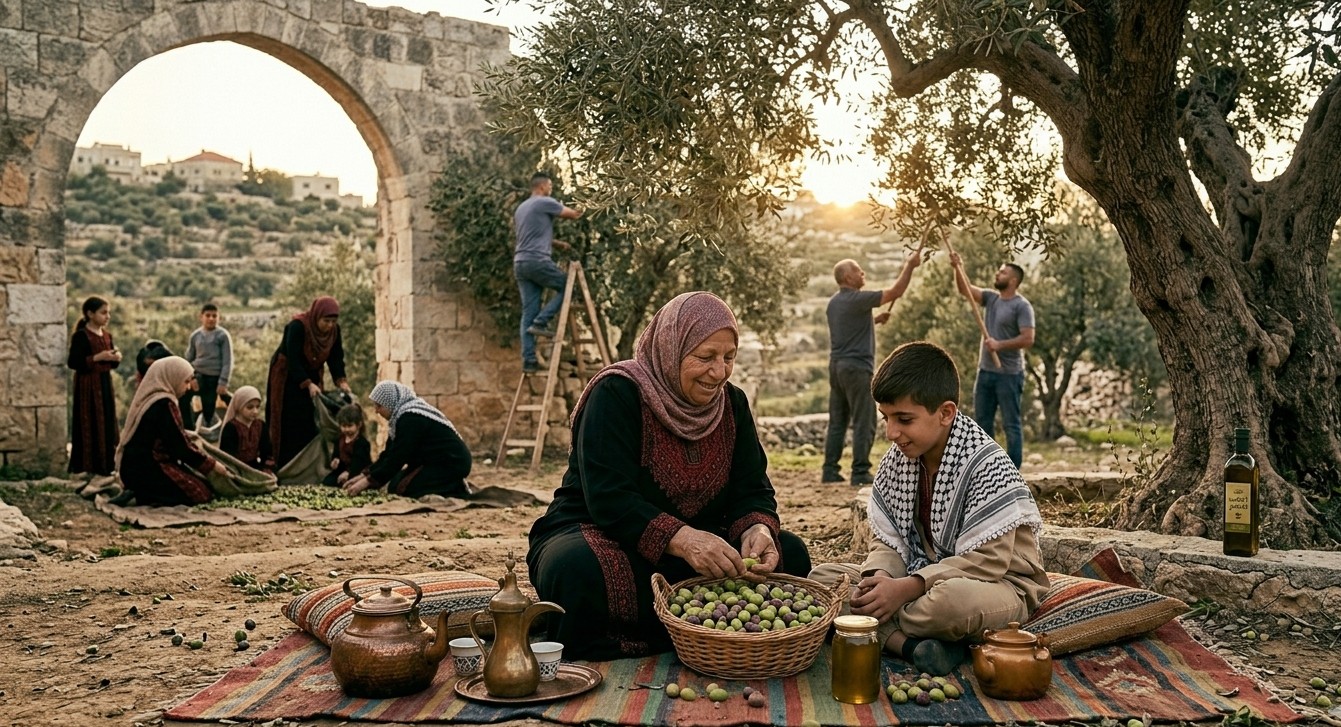
Introduction: The Courtyard and the Emerald Branches
In the ancient courtyard of the house, where the winds whisper the secrets of the mountains, the olives sparkled upon the branches like pure emeralds under the rays of the October sun. Grandmother Laila sat with her customary dignity, wiping the dust off the harvesting mats (Mafārish), while young Hazem watched these rituals with curiosity. He realized they were not merely preparing for an agricultural season, but for a rebirth of identity that binds the earth to the sky.
Details of the Season: "The Picking"—From Branch to Jar
- 1The Wedding of "Al-Awneh": A Palestinian does not harvest their land alone. Relatives and neighbors gather in what is known as Awneh—a culture of collective labor where neighbors support one another in the fields like a single body.
- 2The Process of "Al-Qutub" (Picking): The family begins by covering the ground beneath the trees with mats. Then, the men use ladders to reach the high branches, while the women busy themselves picking from the lower ones.
- 3The Gentleness of "Al-Jadd": The use of heavy sticks to beat the trees is forbidden, protecting the young "veins" of the tree that will carry next year’s crop.
- 4The Art of "Al-Rasse'": After the picking, the fruits are carefully sorted. Large olives are reserved for Rasse'—the art of pressing and pickling olives with secret herbal blends that ensure they stay fresh all year.
A Dialogue of Wisdom: "My Dear, the Olive Tree Knows its People"
Grandmother Laila said, as she sorted the olives with expert hands: "My dear Hazem, the olive tree is not just a tree; it is the face of our home and the support of our backs. When we harvest, we renew the covenant with those who planted and toiled so that we may remain standing. The first oil, my son, is medicine for the soul before it is food for the body; it holds the blessing of the land and the patience of years." She continued, touching the rough trunk of the tree: "My son, the trees whose roots are in the rock are not shaken by the wind. We are like these olives—the harder life treats us, the purer and finer the oil we give. Be like them, Hazem: generous, patient, and impossible to break."
Conclusion: Lamps That Never Sleep
Hazem realized that the olive tree is the guardian of memory that never ages, and that every drop of oil is a signature on the deed of ownership to this land. Even if you are far from your mountains—place a bottle of virgin oil on your shelf, and when its aroma fills the room, you will know that Palestine needs no travel ticket to reach you; its blessing dwells in this liquid gold. As the sun set, olive oil lamps lit every window in the house, as if the earth itself had decided not to sleep until it was sure its light had reached the furthest corner of consciousness. As Grandmother Laila always repeated to summarize the philosophy of self-sufficiency and sovereignty: "Olive oil is the pillar of the house, and loyalty to the land is the root of all truth."