The Palestinian Dabke: The Rhythm of the Earth and Chants of Resilience
"The Dabke is not merely a folk dance; it is the language of bodies striking the earth to declare existence. It is the bond that links shoulders and unites hearts against all attempts at erasure and oblivion."
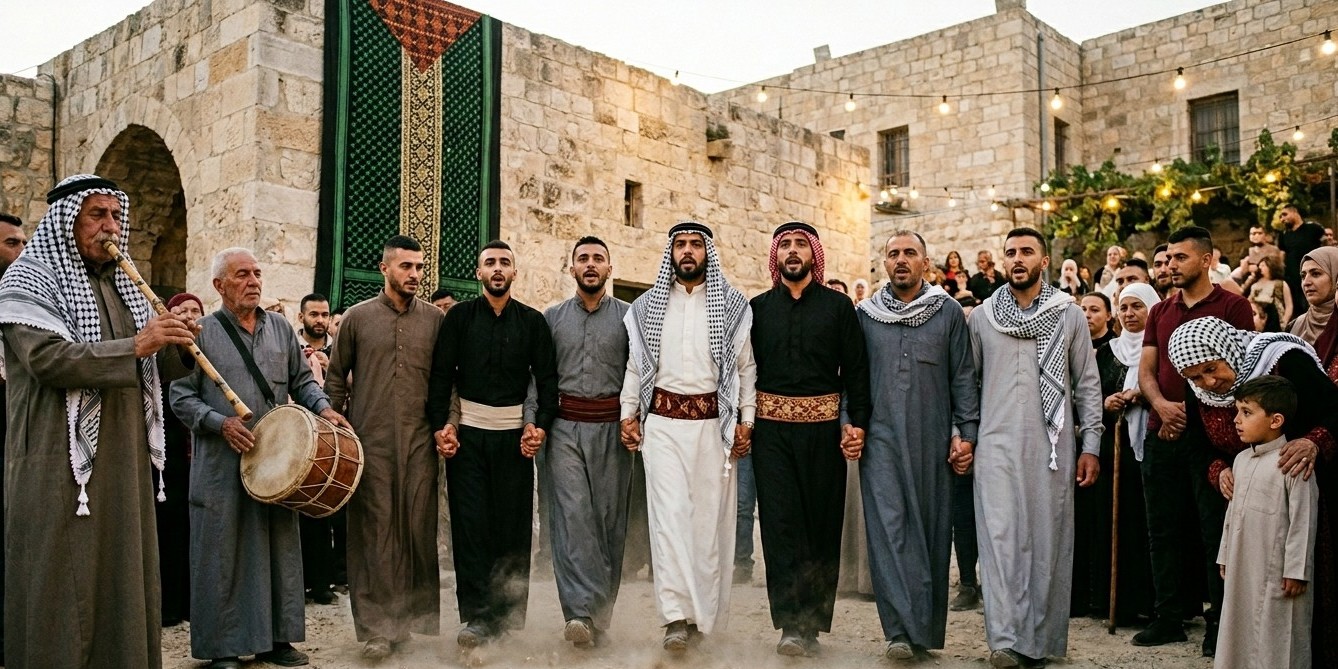
The Earth’s Thud and the Roar of Throats
Under the wedding lights that defy the darkness of the siege, shoulders align and hands interlock to form an unbreakable circle. Adham watches in awe as the rhythmic stomping of feet on the ground transforms into a single pulse that shakes the surroundings. The piercing sound of the Yarghul rises to announce the start of a joyful epic, accompanied by the beats of the Tablah that regulate the ranks. Grandmother Laila leans toward him, saying: "My son, the Dabke is more than a dance; it is a stance of pride and a strike of the foot that tells the earth, 'We are here'." *Yarghul: A traditional Palestinian woodwind instrument consisting of two pipes, known for its powerful, resonant sound that sets the pace for the Dabke. *Tablah: A fundamental percussion instrument, often made of clay or metal with a stretched hide head; it determines the speed of the dance and the strength of the "khabtat" (stomps).
Types of Dabke: A Symphony of Diversity
- 1Al-Shamaliyya (Northern): Characterized by vitality and speed, where the Rowwis leads with agile movements followed harmoniously by the group.
- 2Rowwis: The leader of the Dabke circle who stands at the front, directing movements and transitioning between rhythms.
- 3Al-Tayyara (The Flyer): One of the fastest and most enthusiastic types, requiring high physical fitness and powerful ground strikes.
- 4Al-Dalauna: The most famous and familiar rhythm, where chants of love blend with an eternal attachment to the land and olive trees.
- 5Al-Sha’rawiyya: Known for its composure and tranquility, often reflecting the dignity of elders during celebrations.*Sha’rawiyya: Named after the "Sha’rawiyya" region in Palestine; it is a balanced dance that showcases the prestige of men.
- 6Al-Zareef: Focuses on praising the bride and groom while celebrating qualities of generosity and courage.
A Dialogue of Wisdom: "Supported Shoulders Never Fall"
Adham asked his grandmother while trying to mimic the footwork: "Why must we hold each other’s hands so firmly?" Laila replied, tightening her grip on his hand: "Because, my son, supported shoulders never fall. The Dabke teaches us that strength lies in the collective; the Rowwis leads, but he cannot complete the circle without those behind him. Today, Adham, when we are prevented from walking freely in our land due to checkpoints, the Dabke circle becomes our alternative march—a proof that our identity is one."
Social Significance: The Sovereignty of Joy
- Unity of State: The Dabke expresses social solidarity; the rich and the poor stand shoulder to shoulder in a single circle.
- Declaration of Existence: Preserving the authentic steps and the "khabta" (the strike) is a sovereign act confirming ownership of the land.
- Inheriting the Covenant: Passing Dabke movements from the elderly to the youth is a transfer of the trust of resilience, much like handing over the keys to ancient homes.
Conclusion: An Unbreakable Rhythm
Adham realized that every foot strike on the wedding soil is a cry for freedom that transcends barriers and wire fences. As the Tablah beat intensified and dust rose beneath the feet, he joined the circle, tightening his Mi’zar and striking the ground with all his might. He understood that Palestine—the country where he is barred from roaming freely—dwells within this rhythm that no obstacle can silence. *Mi’zar: A wide belt or shawl wrapped around the waist to support the back and provide stability during the Dabke. *Dabbikeh: The skilled men and youth who participate in the Dabke circle with high proficiency. As the grandmother always repeated, describing the majesty of the dancers: "O Dabbikeh, let the earth tremble beneath your feet; with honor and dignity, let its beauty be complete."