Sovereignty Etched in Memory
How Palestine’s Banknotes and Stamps Preserved the Identity of a Nation
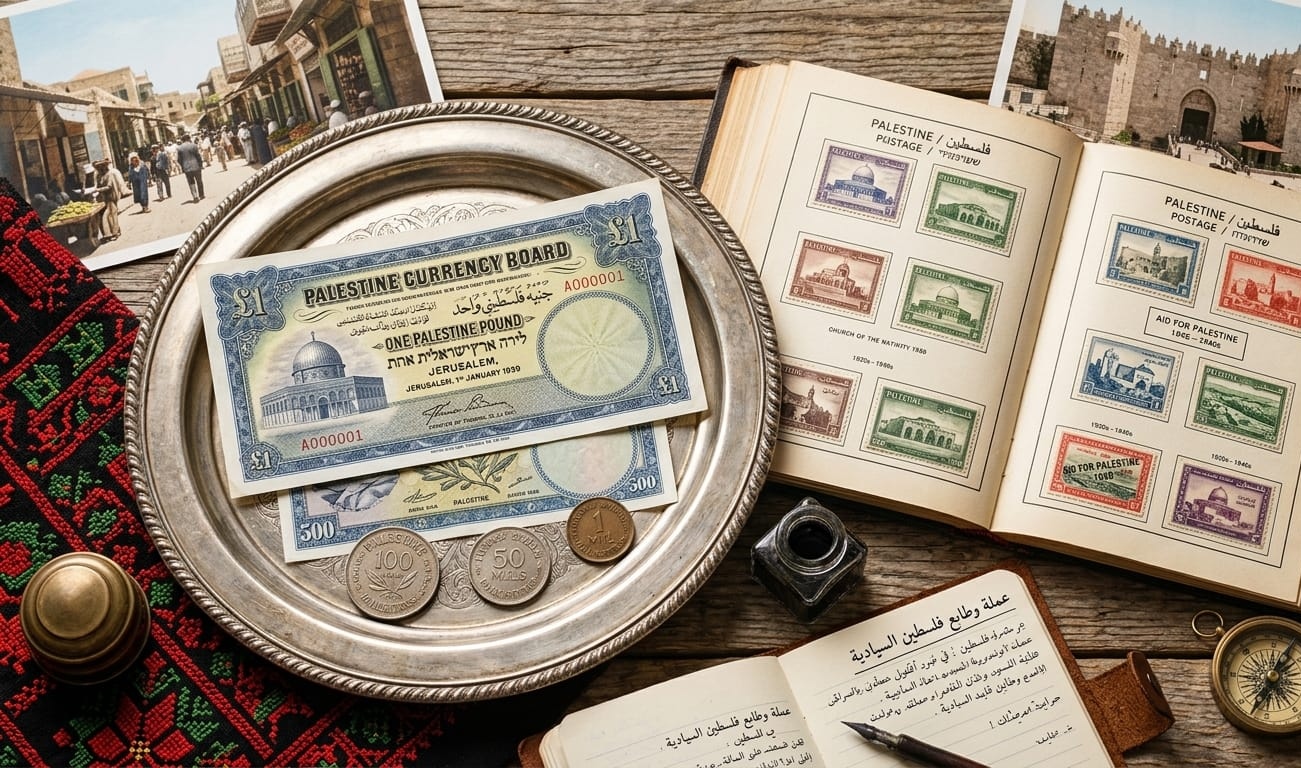
When Currency Became Witness
• The Story of the Palestinian Pound and Postage Stamp Before the Nakba At a time when every effort is made to erase the contours of memory, currency and postage stamps remain among the few documents that cannot be rewritten. They were never merely instruments of trade or tools for delivering letters; they were emblems of sovereignty — tangible proof of a people who lived with remarkable institutional order and civic life long before 1948.
First: The Palestinian Pound — When Money Spoke Three Languages
In 1927, the Palestinian Pound began circulating through the markets of Jerusalem, Jaffa, and Haifa, bringing an end to the use of the Egyptian pound and Ottoman currencies. • Design and Symbolism: The Palestinian Pound was far more than printed paper; it was a carefully crafted cultural statement. Different denominations — from the 500 mil note to the one-pound, five-pound, and even the hundred-pound bills — carried imagery deeply rooted in the land itself. The Dome of the Rock occupied a central place in many designs, alongside landmarks such as the historic Minaret of Ramla. • The Three Languages: The currency was printed in Arabic, English, and Hebrew. Today, despite countless attempts to distort history, these notes remain undeniable evidence that “Palestine” was the official and internationally recognized name of the land in political, administrative, and monetary records alike. • Economic Strength: The Palestinian Pound held equal value to the British pound sterling, making it one of the strongest currencies in the region at the time — a reflection of a thriving Palestinian economy that was deeply connected to the wider world.
Second: Palestinian Stamps — Political Messages in Postal Form
If currency represented economic strength, postage stamps embodied cultural presence and soft power. • The Dome of the Rock and Landscapes Series: Palestinian stamps featured scenes such as the Citadel of Jerusalem, the Church of the Nativity, and Lake Tiberias. These images were never decorative choices alone; they served as visual affirmations of the land’s architectural, spiritual, and historical identity. • Relief and Resistance Stamps: Historical records also speak of “National Relief Stamps,” issued to support revolutionaries and aid communities devastated by conflict. Their existence reveals an early political consciousness within Palestinian society, where even the postal system became a means of collective struggle and national solidarity. • The “Palestine” Stamp in Exile: Even after the Nakba, Palestinian stamps continued to be issued in Gaza under Egyptian administration and across the diaspora, carrying a clear message to the world: a people’s rights do not vanish so long as their name continues to be sealed upon every letter.
Third: Why Document Currency and Stamps Today?
Preserving these artifacts is not simply a collector’s pursuit; it is an act of resistance through memory. To hold a Palestinian Pound bearing the name “Palestine,” or to see a postage stamp portraying its mosques and churches, is to confront the false narrative of “a land without a people.” Palestine was present — unmistakably present — in its official documents, institutions, postal systems, and monetary records, long before anyone attempted to erase its story.