The Pharaonic Era in Ancient Palestine.
When the Nile and Canaan Breathed as One. A Legacy of Diplomacy, Defense, and Cultural Synthesis in Palestine
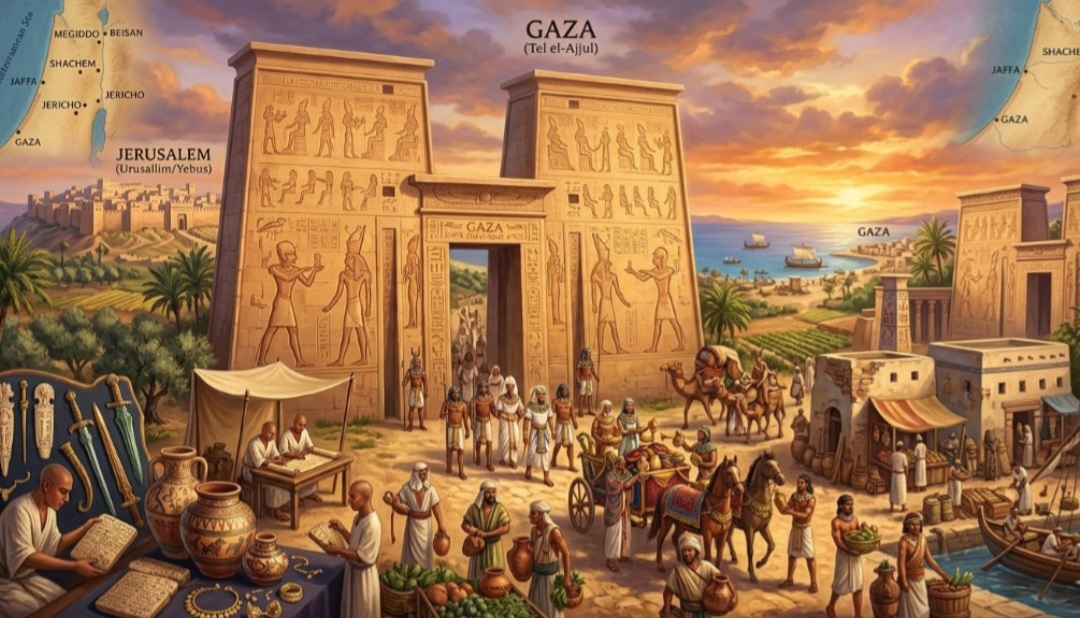
A New Dawn in the Land of Canaan
This majestic odyssey began with the rise of Egypt’s New Kingdom. The Pharaohs looked toward Palestine not as a mere transit corridor, but as a cornerstone of their imperial security and vision—a dominion that would endure for over four centuries.
Palestine: The Pharaoh’s Orchard and Fortress
Egyptian interests were rooted in the protection of the "Great House." The defense of the Nile effectively began at the ramparts of Gaza and Jaffa. Beyond security, this land served as a commercial artery, yoking Pharaonic civilization to the riches of Babylon and the cedars of Lebanon, cementing its status as the beating heart of ancient global trade.
The Footsteps of Kings upon Palestinian Soil
This land bore witness to the stride of history-makers: Thutmose III, who solidified his empire at the legendary Battle of Megiddo; Amenhotep III, whose reign was defined by peace and delicate diplomatic correspondence; and Ramses II, whose citadels in Beth Shean and Gaza stood as beacons of Egyptian prestige.
Governance Through Partnership, Not Erasure
The Pharaonic era did not seek to overwrite the identity of Palestine. Instead, it employed a sophisticated administrative system, allowing Canaanite kings to govern their internal affairs under the mantle of loyalty to the Pharaoh. This fostered a climate of stability and coexistence, where arts, architecture, and linguistics seamlessly intertwined.
Gaza: The Capital That Never Slept
During this epoch, Gaza (Tell el-Ajjul) emerged as an administrative jewel. Serving as the primary seat of the Egyptian governor and a bustling commercial hub, its sophistication is immortalized by the Pharaonic seals and exquisite jewelry unearthed from its soil.
Vocal Witnesses from the Earth
The ruins of Beth Shean speak of formidable military strongholds, while the gate of Jaffa—inscribed with the titles of Ramses II—tells of a time when seafarers were greeted by imperial grandeur. Most vital are the Amarna Letters: human documents that echo the voices of the rulers of Jerusalem and Shechem as they addressed the "House of Pharaoh" with pledges of fealty and urgent appeals.
The Receding Light and the Enduring Legacy
As the sun began to set on the Twentieth Dynasty, Egyptian hegemony gradually waned under the pressures of shifting eras and the incursions of the "Sea Peoples." The Canaanite city-states reclaimed their independence, leaving behind a buried Pharaonic legacy within the hills of Palestine—a testament to an age where two lands shared a single spirit of construction and survival.