The Neighbors' Sakba: The Covenant of Salt and the Memory of Dishes
A philosophical reading of the Palestinian tradition of "Sakba," where the exchange of food transforms into a silent language of resilience and social solidarity, strengthening human bonds across the neighborhood’s pavements.
Introduction: The Geography of Passing Scents
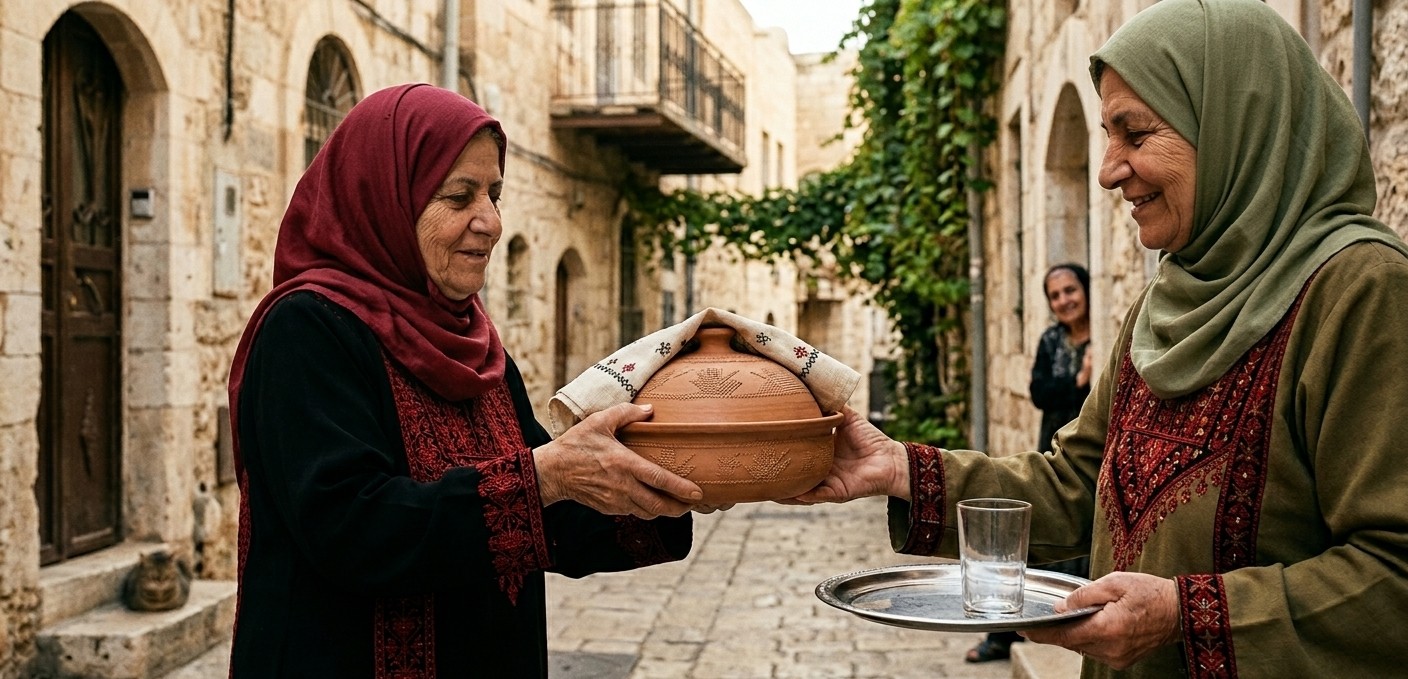
In the ancient Palestinian alleys, where walls lean so closely together they seem to breathe as one, the aroma of food recognizes no boundaries or bolted doors. There, where the fragrance of sage mingles with the sound of pots simmering on low heat, a daily ritual begins that transcends the mere act of feeding; it is the ritual of the "Sakba." It is that spontaneous movement that turns the neighborhood's veins into a pulse of dishes covered with embroidered cloths, roaming between homes like love letters hidden within the folds of sustenance.
The Philosophy of Sakba: The Dish as a Covenant of Security
In the Palestinian consciousness, Sakba is not merely surplus food gifted to others; it is a "philosophy of selflessness" and a breaking of the ego of possession. It is a tacit acknowledgment that "the scent of food is a right," and that the neighbor is a spiritual partner in every morsel. The Palestinian dish transforms into a medium of social communication; it never leaves one house except to return laden with the blessings of another, in an economic and emotional cycle that refuses to let any individual in the neighborhood sleep hungry or alone. It is the soft power that turned "hunger" into an impenetrable enemy. A community that shares its loaf on the neighborhood pavements is a community that possesses an innate immunity against fragmentation. The dish here is the "stake of resilience," and the salt shared between neighbors is the covenant that is never betrayed.
The Role of Woman: The Guardian of Solidarity and Architect of Familiarity
The Palestinian woman stands at the heart of this tradition as the "trustee" of the neighborhood’s emotional balance. It is she who perceives, with her sovereign intuition, which houses have closed their doors on the pride of need, slipping in her "Sakba" as an act of affection rather than chance. It is she who taught generations that a woman of true "origin" (Asala) is one who makes her kitchen a welcoming guest house and her dish a bridge for connection. She is the woman who preserved the "collective consciousness" by ensuring neighbors' dishes are returned clean and filled, believing that the dignity of the neighborhood is an extension of the dignity of the home. Preserving this custom is the guarding of the last bastions of humanity in the face of challenges.
Conclusion: The Covenant Written in Oil and Thyme
The "Sakba" is the living embodiment of the Palestinian ethos of resilience (Sumud); it proves that the collective is stronger than the individual, and that solidarity is not a system imposed but an identity lived. These dishes crossing between homes will remain the faithful guardians of our memory and the truest witness that we are a people who build our homeland upon the pavements of love before building it upon the soil. "The land whose people feed one another with an honorable morsel is a land that neither hungers nor falters; for loyalty begins with the neighbor’s dish and ends with the sovereignty of the home."